19 Front Street


19  FRONT  STREET

(A Vintage Vignette by John P. Rankin)
Originally written May 23, 2010
Updated November 19, 2012


Madison Belles -2010
Several years ago I wrote of the mansion built by James Edward Williams at 19 Front Street in the historic original downtown part of Madison, on the north side of the railroad tracks between Sullivan Street and Church Street.  

The impressive multi-story home with wrap-around porches on two levels proudly graces the Front Street line of old houses reflecting the glory of Madison in the early 1900s.  The back wing of this house was built around 1869 by William B. Dunn, Madison’s first railroad depot agent, who was also a physician.  Dunn was a brother of Jackie Dunn Wiggins, who lived on a plantation east of today’s jetplex.  The two-story part of the house was constructed by Jim and Mattie Whitworth Williams around 1904, incorporating Dunn’s house as part of the dwelling, which makes it probably the oldest house standing within the historic town limits of Madison.  

The home was purchased and saved from decay by Chris and Lynn Crumbley in January of 2011.  They have restored the structure to its former glory, making interior improvements that considerably added to its modern functionality and decor while retaining the historical features.
J. E. Williams, raised in Madison, forms a splendid example of what an ambitious man may accomplish by grasping opportunities that abound in this community.  He started in young manhood (at age 16) sharecropping on the farm of Dr. W. F. Pride in 1883.  In the year 1892 he had accumulated enough funds to purchase a farm of 180 acres, from the proceeds of which he bought in 1896 another tract containing 640 acres.  In 1900 he added 280 acres to  his possession.  In 1903 he added another parcel of 560 acres and still more all along the way.  Commencing without funds he has pushed forward.  He has surmounted every difficulty, gradually building upward all the time until he now owns four large farms aggregating about 1900 acres.  His farms are worth an average of about $20 per acre.  The annual production of the farms is conservatively estimated to be about $18,000.  Mr. Williams also raises considerable livestock, especially cattle, which he uses in his own market in connection with his mercantile establishment.  Thereby he assures his customers the best meats at lowest possible prices.  Aside from a full and complete line of merchandise, in which may be found just about anything that could possibly be needed in the home or on the farm, he also handles farm implements.  He has just now begun supplying a long-standing need of the town by establishing a first-class livery stable.  Mr. Williams has assisting in his business those two ‘old reliable’ clerks, Tom W. Carter and Arthur H. Lewis.


The June 2010 Madison street tours sponsored by the Huntsville/Madison County Convention & Visitors Bureau began across Front Street at the nearby Roundhouse.  The “Madison Belles” (young ladies in antebellum costume) assisted.  That particular year of the street tours included access to the first floor of the unoccupied Williams mansion.  Because of inclement weather that arose, a slide show of selected historic Madison photos was presented for the touring public in the dining room of 19 Front Street as a substitute for walking in the rain to see other historic homes.

The 1913 newspaper misstated Williams' childhood to a degree.  He was not “raised in Madison,” but rather on a farm in Limestone County near Madison.  On the other hand, the newspaper included not only the life story article, but it also printed a photo of the house and a photo of the man, with the caption “Mr. J. E. Williams, Alderman, Merchant and Planter”.

After the newspaper's  publication, Williams incorporated
Madison Telephone Company on March 4, 1919.  This was at a time when most towns in the South had no such instruments.  

For those who want to know more about the man and the mansion, additional details and connections can be found on CD-ROMs or DVDs available from the Madison Historical Society.  There is also related coverage in the sesquicentennial book of Madison, available at Main Street Cafe and Madison Station Antiques on Main Street in Madison.


Jim and Mattie Whitworth Williams
in their home, circa 1910

112 Church Street Wann - Curry Home

This is the home of Gordon and Monica CurryThe tax assessor's records show it as having been built in 1935but often it is known that structures are older than those records show. It is also known that this was the home of William and Vida Wann. William was a merchant at 206 Main Streetpreviously the store of Dea Theodore Thomas. Wann operated the store with general merchandise from 1917 to 1940. Thomas had it from 1904 to 1917. Considering the time of Wann's merchandising on Main Streetit is believed that he may have constructed this house before 1935, but research of the history is not yet completed.

The census of 1920 shows William as age 33, born in Alabama around 1887. His wife Vida was listed then as 32, also born in Alabama. In the 1930 census, Vida was living on Front Street as a widow, making a living as a bookkeeper in a dry goods store.

110 Church Street Canterbury - Keebler Home

This distinct and impressive house was the home of William E. Canterbury and his wife Matilda BinfordWilliam was listed in census records as a farmer in 1920but as a salesman and clerk in a general store in 1900 and 1910. He was born at the end of the Civil War in 1865, a son of Thomas Canter­bury who was a Confederate Army veteran. William married Matilda in 1904, and in 1905 they bought the house and lot on Church Street from Frank G. Hertzler and Harvey Anderson.  This purchase was recorded in Deed Book 91, page 598.

When William Canterbury had a store, it was located in what has more recently been Hughes Hardwarethe two-story building south of the railroad tracks216 Main Street. Matilda died before the 1930 censuswhen William was listed as a widower. William was a nephew of an older William Canterbury in the townbut that one had the middle initial "J." William J. Canterbury lived on the west side of Sullivan Street, in the Pension Row area when it had a Masonic Lodge that shared a building with the Cumberland Presbyterian Church thereWilliam J. was listed in the 1900 census as a farmerbut in 1910 and 1920 he was shown as a preacher or minister. Perhaps he preached in the Presbyterian Church near where he lived. His wife was Katie K., who was about 15 years younger than William J., who died in 1941 at approximately age 98.


Vintage Vignette: Rules For School Teachers - 1915


(A Vintage Vignette by John P. Rankin, May 2, 2010) 

1903 Madison Training School

x
Before Percy Keel passed away in January of this year, he gave me many of his historical collection items for safekeeping.  Among them is a large three-ring binder of clippings about the history of Madison schools with notes of their pupils and staff in the early 1900s.  Within that notebook is a page entitled “Rules for 1915 Schoolteachers” attributed to Buckeye Farm News, which in turn quoted from an unnamed teachers’ magazine of the day.  Whether or not any of these rules were ever applied here is not known to me, but they certainly would have fit 1915 life in the town of Madison, judging from other items of the time that I have found.  The rules are repeated here to perhaps illustrate to some degree how much times have changed.

·        You will not marry during the time of your contract.
·        You are not to keep company with men.
·        You must be home between the hours of 8 p.m. and 6 a.m., unless attending a school function.
·        You may not loiter downtown in any of the ice cream stores.
·        You may not travel beyond the city limits unless you have the permission of the chairman of the board.
·        You may not ride in a carriage or automobile with any man unless he is your father or brother.
·        You may not smoke cigarettes.
·        You may not dress in bright colors.
·        You may under no circumstances dye your hair.
·        You must wear at least two petticoats.
·        Your dresses must not be any shorter than two inches above the ankle.
·        To keep the schoolroom neat and clean, you must:  sweep the floor at least once daily; scrub the floor at least once a week with hot, soapy water; clean the blackboards at least once a day; and start the fire at 7 a.m. so the room will be warm by 8 a.m.

Obviously, these rules were developed with the assumption that only unmarried women were to be teachers.  It is not clear today why loitering in an ice cream store would be disallowed, but probably that would be taken back then as an indication of a young lady of loose morals being available for approach by a lecherous male.  Apparently, schools of the day were extremely careful to maintain a strict image of absolute propriety by those who were shaping the lives of young students.  It was also “good for business”, as schools in those days were generally attended on a voluntary and personal cost basis.  Accordingly, parents had to be constantly convinced of the proper conduct of those associated with any school where they would pay to send their children.

The December 17, 1913, special “Madison Booster” issue of THE WEEKLY MERCURY (a newspaper of Huntsville) stated that “More good and less bad can be truly said of Madison than of any other town and community of same population anywhere on earth… where the health conditions are unexcelled and where the best of schools are to be had, a high moral place of pure society, and where the effect of a wholesome religious influence is manifest on every hand….”

The Vintage Vignettes were originally a series of eight articles for publication in the Huntsville Times newspaper over a period of five years, 2007 - 2011. The articles in this eight-page historical newspaper issue were compiled by J. Willis Cargile.  He concluded his coverage with:
“Visit the attractive little city of Madison; it’s well worth your while….  We cannot ring off without adding a little post-script, commending the noble young people of that model little city for their sterling qualities and refined daring.  It is noticeable that the young men of the community love their homes and are entering into pursuits in their own town, and there are many merry Madison maids, who prefer home and mother in preference to parading the streets and gathering at the (railroad) Depot to flirt with the blue coats and brass buttons who may have daughters at home older than they are.  All Madison is proud of the elevated society among her most worthy and highly refined young gentlemen and young ladies.  There are many, many more good things to be said about Madison.”

Pension Row

MADISON'S  PENSION  ROW

by John P. Rankin


Doctor George Richard Sullivan, namesake of Sullivan Street, lived in his later years in a house on the west side of Sullivan Street near the north end of Pension Row.  The street named Pension Row runs through the middle of early Madison's westernmost development.  The name is thought to derive from a number of WW1 military veterans living on their service pensions along the street.  Prior to that time, this neighborhood was home to Madison's Male and Female Academy, which was in operation near the south end by 1883 or earlier.  Just north of that was an early 2-story Masonic Hall that was shared by a Presbyterian Church using the ground floor.  The two organizations met there on different days.

By 1926 the Masonic Lodge hall was used for the education of African American children until Cornelia, widow of blacksmith Henry Seay, deeded land on Pension Row for a new school.  In 1936 the W.P.A. provided materials, and local citizens provided the labor to erect a 3-room building.  Mr. L. C. Jamar was principal 1926-1947.  He was followed by Mrs. Dorothy Turner  for a short time, and in 1948 Rev. E. C. Binford became principal.  During his tenure, the school expanded twice, to a 5-room configuration and then to 16 rooms, with teachers for each room.  The expanded school consolidated those of nearby area schools in Triana, Capshaw, New Haven, Union Hill, Betts, and St. James, which had been meeting in churches and other lodge halls.  The Pension Row School burned in 1949 and was not rebuilt in that neighborhood.  West Madison Elementary School was constructed further north to replace it after several years, with an integrated staff and student body by the 1970s.

Information For Historical Marker:
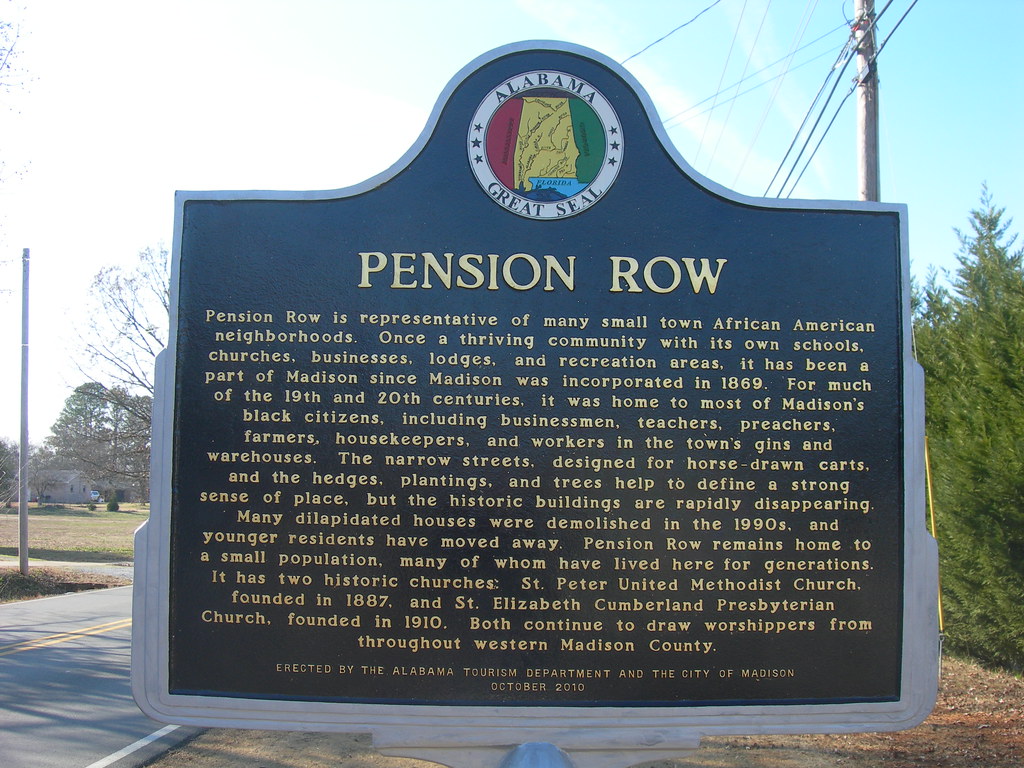
"Pension Row is representative of many small town African American neighborhoods. Once a thriving community with its own schools, churches, businesses, lodges, and recreation areas, it has been a part of Madison since Madison was incorporated in 1869. For much of the 19th and 20th centuries, it was home to most of Madison's black citizens, including businessmen, teachers, preachers, farmers, housekeepers, and workers in the town's gins and warehouses. The narrow streets, designed for horse-drawn carts, and the hedges, plantings, and trees help to define a strong sense of place, but the historic buildings are rapidly disappearing. 

Many dilapidated houses were demolished in the 1990s, and younger residents have moved away. Pension Row remains home to a small population, many of whom have lived here for generations. It has two historic churches: St. Peter United Methodist Church, founded in 1887, and St. Elizabeth Cumberland Presbyterian Church, founded in 1910. Both continue to draw worshippers from throughout western Madison County."


Location:

Coordinates:N 34° 41.747    W 086° 45.304
 34.69578333    -86.75506666

Pension Row Historical Marker
211-299 Arnett St
Madison, AL 35758

110 Main Street Madison, AL 35758


Believed to be one of the oldest stores in Madison, the building was built circa 1859 and owned by Mr. George Washington Martin.  Later,  Mr. Hardage operated a saloon in the building which was one of two in Madison at that time.


Sometime thereafter, Mr. Robert Parham Cain bought the building and opened and operated a grocery store.  His son Mr. Robert Earl Cain continued in the mercantile business there.

From MSHPS Nomination: 110 Main Street (1859) faces northwest. This two-story, painted brick commercial building is believed to be one of the oldest commercial structures in Madison Station. The front-gabled roof includes overhanging eaves with decorative brackets. The large upper story windows are six over six sash with true divided lights. The recessed front entrance has two large display windows and a sign band that runs the width of the entrance. 


The building is said to have housed a local saloon at one point and later a grocery store. CONTRIBUTING


Today, the building houses Madison Station Antiques.

Visit them on Facebook.


Other Links about this location:


Click Here for Next Location on tour: 303 Church Street


Click here for the Madison Station Historical Preservation Society Tour.

303 Church Street Madison AL 35758

The Walton Hughes home was built in 1922 by Mr. Thomas J. Riddle (principal of Madison School) for Harry, his son. Harry and his father worked as bankers and lived next door to each other. Both Riddle families left the Madison area in the 1920's.
In 1926, Mr. Walton Hughes bought the property. Mr. Hughes was the owner and pharmacist at the Humphrey-Hughes Drug Company on Main Street for fifty years.
The home is a Gothic structure with a bungalow porch. It is one of two homes in the district with a cupola on the top.


Click here for the Madison Station Historical Preservation Society Tour.